Showing posts with label Leopard Facts. Show all posts

Thursday, 1 January 2015

Questions and Answers


Q: How do you know when a leopard is not stalking it's prey?


Answer:

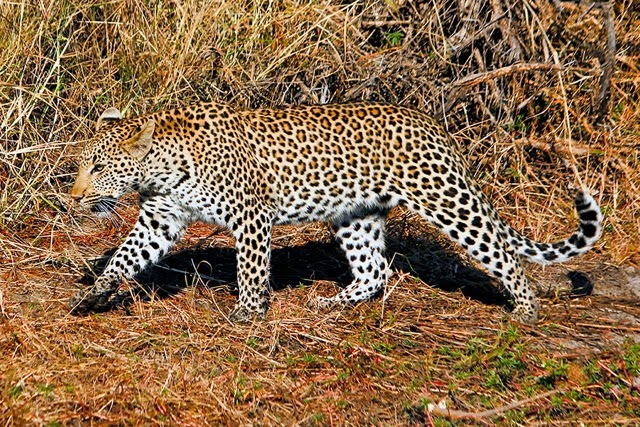
When a leopard stalks prey, it keeps a low profile and slinks through the grass or bush until it is close enough to launch an attack. 

When not hunting, it can move through herds of antelopes without unduly disturbing them by flipping its tail over its back to reveal the white underside.

Q: Which other predators do leopards need to avoid in the wild?


Answer:

Both lions and hyenas will take away a leopard's kill if they can. To prevent this leopards store their larger kills in trees where they can feed on them in relative safety.


Q: Leopards are solitary creatures, so why do they sometimes allow other leopards into their territory?


Answer:

The solitary Leopard each  has a large territory. They mark their ranges with urine and leave claw marks on trees to warn others to stay away. Male territories are larger than females. They only overlap when the intrusion is tolerated for mating purposes. 

Q: Are leopard spots round or square in shape?


Answer:

Leopards come in a wide variety of coat colors, from a light buff or tawny in warmer, dryer areas to a dark shade in deep forests. In newly born leopards, their coats appear to be smoky gray as the rosettes are not yet clearly delineated. The spots, or rosettes, are circular in East African leopards but square in southern African leopards.


Send us your questions and we'll share the answers with you!


Tuesday, 23 December 2014

10 facts on Snow Leopards


Fact 1: 

They're up to 125 cm long

Snow leopards are between 86-125cm long - and that's not including the tail! They weigh between 22-52kg, but males will be around a third larger than females.

Fact 2: 

They have their own snow shoes.

Snow leopards have wide, fur-covered feet that act as natural snowshoes. These help to distribute their weight over soft snow and protect the soles from the freezing cold.

Fact 3: 

Snow leopards use their tails like scarves.

Snow leopard's tails are thought to help them balance, but they also wrap them around themselves to keep warm. Handy!

Fact 4: 

Snow leopards can't roar.

Unlike other big cats - like lions and tigers - snow leopards can't roar.

Fact 5: 

They can jump nine metros.

Some snow leopards have been known to leap up to nine metres - that's six times their body length.

Fact 6: 

Snow leopards are born in fur lined dens.

Snow leopards first reproduce at around two and a half years old. Usually two or three cubs are born in spring or early summer in a well-concealed den lined with the mother's fur.

Fact 7: 

Snow leopards are born blind.

Cubs are born blind and don't gain their sight until they're nine days old. They are fully active by two months old and stay with their mother until they're two years old. By this time they're fully independent.

Fact 8: 

Snow leopards live very high up in the mountains.

Snow leopards are sparsely distributed across 12 countries from southern Siberia to the Tibetan Plateau. 

Snow leopards live at high altitudes, usually at elevations of 3,000 to 4,500 metres - but they've been seen above 5,500 metres in the Himalayas!

Fact 9: 

They hunt animals three times their size.

Snow leopards can kill prey weighing as much as three times their own body weight. Snow leopards' main prey are the ibex, blue sheep and Himalayan tahr. One blue sheep will provide a snow leopard with food for one week.

Fact 10: 

Their tails are nearly as long as they are.

Snow leopard tails are between 80 to 105 centimetres long.

Tuesday, 9 December 2014

5 facts about Leopards and Man


George Schaller holding snow leopard cub. credit: D.DeMello©Wildlife Conservation Society


Did you know?


  • Leopards have long been preyed upon by man. 

  • Their soft, dense, beautiful fur has been used for ceremonial robes and coats. Different parts of the leopard the tail, claws and whiskers are popular as fetishes. 

  • Leopards have a reputation as wanton killers, but research does not support the claim. 

  • In some areas farmers try to exterminate them, while in others leopards are considered symbols of wisdom. 

  • If captured, Leopards do well in captivity and some have lived as long as 21 years.


Monday, 24 November 2014

Bite size stories November

Leopards are fascinating creatures. 

We love learning about these majestic animals and sharing interesting stories about them.

Today we share 3 bite size stories with you:


The Loving Leopard

During the National Geographic programme ‘Eye of the Leopard’, a wild leopard killed a baboon in order to feed herself. However upon noticing an infant baboon clinging to the dead baboon, the leopard amazingly carried the infant up to the safety of the tree to guard her from hyenas. She groomed and cuddled the baby throughout the night, caring for him/her as she would her own cub.


Leopard or panther?

Leopards tend to have distinctive dark spots called rosettes, which create beautiful patterns against their otherwise light fur. Black leopards however have dark fur which makes it difficult to see the spots. They appear almost solid black and are often called black panthers. 


Purring Kitty Cat

Like cats kept as companions, leopards will purr when content. 

They have various vocalizations such as a rasping cough which they perform to announce their presence to other leopards. Leopards growl and spit with a screaming roar of fury when angry.


Find out more here

This leopard is the Wallingford male, from Sabi Sands western sector, photographed on 31 ‎January 2014.

Monday, 3 November 2014

8 Facts about Leopards

Today's post features the one eyed Safari female, Arathusa from northern Sabi Sands. 


Leopards are well known for their cream and gold spotted fur, but some leopards have black fur with dark spots. These black leopards are often mistaken for panthers. 

Leopards are part of the cat family, Felidae. The scientific name for a leopard is Panthera pardus.


Adult leopards are solitary animals. Each adult leopard has its own territory where it lives and, although they often share parts of it, they try to avoid one another.


Leopards are mostly nocturnal, hunting prey at night.

Leopards protect their food from other animals by dragging it high up into the trees. A leopard will often leave their prey up in the tree for days and return only when they are hungry!


Female leopards give birth to a little of two or three cubs at a time. By the time a cub is two years old it will leave the company of its mother and live on their own.


When a female leopard is ready to mate she will give a scent and rub her body on the trees to leave her smell there. Male leopards either smell the females scent or hear her call to know that she is ready to mate. 

Sad fact: Some people believe that the bones and whiskers of leopards can heal sick people. Many leopards are killed each year for their fur and body parts and this is one reason why the leopard is an endangered animal.

Thursday, 23 October 2014

Leopard ID Project CSI


CSI stands for Cat Spoor Identification.

One of the most fascinating facets of a safari experience is watching the highly skilled trackers interpret the bush from the signs left behind on the road.  The art of tracking is acquired skill and whilst some are blessed with natural ability, as in all skills, it is not something that can be learned from a book.  

Most of the local trackers working in the Kruger area have grown up in the area and been taught by their fathers and also attended courses to refine their skills.  For many, looking after the family’s cattle as a child has helped to develop their abilities and one of my former trackers once told me that his responsibility was to find the cattle each morning and this meant learning to distinguish his father’s cattle from the neighbour’s, merely by looking at the spoor!?

The most commonly tracked animals on safari are the lion and leopard.  Both belonging to the cat family (felidae) they share many similarities (taxonomy uses foot structure as one of its classification methods).  The 2 main clues that the trackers look for when identifying a track are the back pad and the presence or absence of claws.  

All cats, from your cute little kitty-kat at home to the lions and leopards that roam the African bush, have 3 lobes on their back pad.  Only the felines display this trait and for those of you with domestic cats, you are welcome to check this!  The dog family (canidae) and hyena family (hyenidae) only have 2 lobes.  With a large number of hyenas wandering through the landscape after dark, this is the first detail of the track to check to eliminate misidentifying the spoor. 


The second important characteristic to check is whether there is any evidence of claws.  All cats have retractable claws and thus, any lion or leopard track will show no trace of claw impressions in the substrate.  Dogs’ and hyenas’ claws are always exposed and in the soft sandy roads of Sabi Sabi, they are usually visible, thus enabling us to achieve a positive identification.  

There are exceptions to every rule of course…the cheetah has 3 lobes on its back pad and semi-retractable claws which do leave impressions in the substrate.  This however, makes it easy to recognize as is the only animal here to have both traits.

Once the track has been established as a ‘cat track’, the next part of detective work is to identify the species involved and this is done simply by size.  A large male lion for example can reach over 200kgs whilst a large male leopard 80kgs.  Therefore, a lion track is much larger than a leopard’s as a larger surface area is needed to carry this extra body weight.  In both species, size again should be able to define the sex due to the weight difference between males and females.

 Specifics can also be assumed due to the individual characteristics of the track.  For example, in all animals, the front feet are larger than the back due to the weight of the head and shoulders and this will be reflected in the shape of the spoor.  The front paw of a lion will be far larger and broader than the back.  Right and left can also be distinguished by looking at the toe arrangement.  If you look at your own hands for reference, you will see that your outside finger (i.e. little finger) is the shortest.  This is exactly the same in animals and so if you can identify which toe is the shortest or closest to the pad, this will show you whether it is the right or left paw.


This picture above shows both male lion and male leopard tracks.  The larger track on the right is from a male lion and due to its size, we know that it is the front right foot by looking at the details:  the impression is too large and broad to be a back foot and you should clearly see that the furthest right toe is the shortest, thus telling us it is a right front foot.  The tracks to the left are from a male leopard.  Here you can clearly see the size difference between the two cats.  

The track the closest to the bottom of the photo is the front and the one in front is the rear foot.  Again, you can see the size difference between the two and at a standard walking gait, the back foot usually outpaces the front.  This will obviously change should the animal be trotting or running.  The front paw’s toes are obscured by the standing water but in the back foot, again it is the furthest right toe that is closest to the pad and thus can be assumed to be a right paw.

The art of tracking is not something that can be learned in a book and can only be achieved through experience.  

The interpretive skills of trackers are fascinating and guests and rangers alike can learn so much from these wise men.  They are the CSI division of the safari department!  Where they really come into their own is with aging the tracks.  They will look for signs of weathering from environmental factors and the presence of other tracks on top of the spoor to name a few.  The trackers are the unsung heroes of the bush and whilst your ranger can explain the bush to you, these elite men can read it better than anyone.  

Monday, 22 September 2014

How Leopards Hunt


  • Leopards must be within 5-10 meters to catch their prey. 
  • They either stalk and pounce or make a quick running dash toward the animal. 

Snarling leopard fromApril 13 2013, S28 $kms from Crocodile Bridge 
  • Leopards are very opportunistic and only have 50% hunt success rate. 
  • They are the only animal that uses gravity hunting: sinking a killing bite to back of their prey's neck or throat or skull.

  • Leopards will feed on a carcass for up to 4 days. They plucks the animal's fur or bird's feathers before eating it.
  • They are outranked only by Hyena when it comes to the ability to eat rotting meat.


About to pounce, from 24 Sep 2010, S3, 2kms west of H11
  • Leopards will normally de gut prey before eat. They will usually cover it up or bury the gut so not to attract other predators or scavengers.
  • A single leopard will eats +- 60 animals a year. That is the equivalent of 1000 – 1200kg of meat.

Thursday, 18 September 2014

Where to find a Leopard


Ravenscourt young male on 25 Dec at Singita Sabi 

Leopards can be found in a variety of different locations and thats one of reasons it's so important for you to send us the exact location of where you took your picture - so that we can track their whereabouts and movements for you.


Leopard by the lake on 23 july 2013 at Lake Panic

Their Territories depends on availability of prey and den sites. Leopards are solitary and territorial.
Typically a male will cover a territory of 16 - 96 km2 overlapping up to 6 female territories of 5,6 – 30 km2.

Territorial males’ priorities are females, whilst females have priorities to food and den sites.


Leopard in the sand on 28 June 2013, H14, 1km from H9, Kruger National Park

The Movement of leopards is mostly nocturnal, but do move around during the day. They start getting active 45mins before sunset and stop 2-3 hours after sunrise.


Leopard looking up on 28th Sept 2013 at Lubylube

Both sexes spray urine, while the males also scrape the ground with their hind feet. Urine is used as territorial marker and rubs off when they walk.


  • Leopards urine smells like butter popcorn. 
  • Males detect females on heat from the smell of their urine. 
  • Leopards reach a top speed of 60 km/h over short distances, before tiring.


Panting leopard on 29th Dec 2009 at S28 8kms north of H4-2


Monday, 15 September 2014

By a Whisker


It is no coincidence that the diameter of a leopard’s whiskers is wider than the width of the body.  This therefore allows them to gauge the distance between objects and make a judgment of whether they can pass through.

Whiskers are present in a variety of places on a leopard’s body, but most noticeable are the macro vibrissae which are situated on the sides of the muzzle.  
They are noticeably longer than the other hairs enveloping the body and are made of a sturdier keratin.  These vibrissae are not randomly positioned either.  If you look closely, you will see that the hairs are shorter in the front and longer at the back, thus allowing for an ordered grid of arcs to interpret its surroundings. 


The whiskers are set into a special hair follicle that contains a tiny capsule of blood, known as a blood sinus.  When the whisker is caused to move by an external stimulus, the blood in the sinus is pushed one way or the other.  The blood helps to amplify the movement and allows the nerve ending to detect extremely small sensations.  


  • Whiskers are the sensory appendages that leopards, and all felines, use to interpret the world around them.  

  • The scientific name for a whisker is ‘vibrissae’ and comes from the Latin, ‘vibrio’ meaning vibration.  They are used for a variety of functions but most commonly as spacial sensing device.

  • Each whisker can have as many as 200 individual nerve cells which will then pass on this information to even more numerous nerve receptors deeper within the cat’s body. 
  • A leopard will have approximately 30 whiskers on each side of its face and thus have access to over 30,000 nerve receptors!  (To put this in perspective, our fingertips have about 2500 receptors per cm2.)  
  • The whiskers are so sensitive that they can even sense vibrations in the changing air currents and can therefore add another dimension to the way in which they perceive the world.
  • Leopards whiskers are the longest of any of the felines, in relation to their size.  


Their nocturnal tendencies and dense habitat preference have caused them to evolve to be masters of their domain.  Negotiating through thick riverine vegetation in the dead of night would prove extremely troublesome if the leopard was not able to gauge the size of an opening.


This is also important in stalking prey as it allows the leopard to brush against less vegetation and thus make less noise, enabling it to approach close by before pouncing.  The whiskers’ position next to the mouth also allows the leopard to judge exactly where to deliver the killing blow.  

It is hard to see exactly where your mouth is, so the whiskers act as a guide in the same way that birds have rictal bristles to facilitate prey capture.  The highly specialized and sensitive vibrissae are just one of many adaptations that had enabled the leopard to become the world’s most widely distributed wild cat.


(Text by Ben Coley)


Monday, 1 September 2014

6 Leopard Mating Facts


Photo credits: 


1.)
  • Female leopards are very flirtatious with the males. They will will rub cheeks with male, initiating the mating session every time by presenting the copulatory crouch. This position signals that she is ready for the mating to begin.  
2.)

  • Each  mating session is ended with a paw swat by the female, at the males face and a ‘bubbling sawing' sound at 15-minute intervals. 
3.)

  • Their Estrus (this is a recurring period of sexual receptivity and fertility in many female mammals, otherwise known as 'being on heat') lasts 7 days and takes place every 46 days until conception occurs. 
4.) 

  • Mating is very painful due to the fact that the male leopard has a barbed penis!
5.)

  • The female rolls on to her back after each session, in order to ensure conception.

6.)

  • Females will reproduce every two and a half years or when new males when taking over a territory.


Have you ever seen Leopards mating? Let us know by leaving your comments after this post!

Friday, 29 August 2014

Leopard cubs


The Mother leopard will be pregnant with two or three cubs at a time. Her gestation period is short - only 100 days because she needs to be able to hunt as much as possible. When she gives birth, her cubs will weigh on average 500grams and will be born with their eyes shut.


This incredible image of an unborn leopard was taken by Peter Chinn for www.lifenews.com 

Mothers give birth in very dense areas, where it is easy to hide. The cub mortality rate is more than 50%, due to lions, hyenas and even snakes preying on the vulnerable cubs. 

The predators natural instinct to eliminate competition, so even though they do not see the leopard cubs as food, they know that when they develop and grow up they will become dangerous competition for them!


Machaba Camp cub

It takes the cubs 6 weeks before they venture from hiding and start to explore. 

Playtime is crucial to the development of cubs. They are very inquisitive, quick to learn and have a natural instinct to hunt, almost immediately. They will even stalk their mothers tail to begin practicing for the real hunts in the future!

When the cub reaches 3kgs in weight (around the age of 3 months) they will be weaned off their mothers milk as its almost time for them to start hunting for themselves...


Machaba Camp cub

Mothers will spend 50% of her time with her cubs and 50% of her time away -  but she'll keep within 2 km until the cubs are 4 or 5 months old. After that point , her cubs will join her to assist on her hunts or hunt alone.

After this stage in the cubs lives, they can have reunions with their mother until she decides to mate again or has new cubs. Ultimately, the Mother will start pushing her cub away when it starts becoming competition in hunting for food.

In the bush, it's survival of the fittest and each to their own. Blood is not thicker than water when the playing fields are leveled! 


The above picture is Nthombi's cub, taken in Timbavati, Aug 2012

Cubs become independent at 18 months. Between the ages of two and four they are sexually mature and ready to start their own reproductive cycles. 


Want to find out about Leopards mating? 

Check in again with us on Monday, where we'll be sharing more leopard facts with you.


Friday, 15 August 2014

The Subspecies of Leopard

Theses are the nine subspecies of Leopard, as recognised by IUCN: 


1. African leopard 
(P. p. pardus) 
Linnaeus, 1758
Inhabits sub-Saharan Africa

2. Indian leopard
(P. p. fusca) 
Meyer, 1794
Inhabits the Indian Subcontinent

3. Javan leopard 
(P. p. melas) 
Cuvier, 1809 
Inhabits Java, Indonesia

4. Arabian leopard 
(P. p. nimr)
Hemprich and Ehrenberg, 1833
Inhabits the Arabian Peninsula

5. Amur leopard 
(P. p. orientalis) 
Schlegel, 1857
Inhabits the Russian Far East, Korean Peninsula and Northeast China

6. North Chinese leopard 
(P. p. japonensis) 
Gray, 1862
Inhabits northern China

7. Persian leopard - initially described as Caucasian leopard (P. p. ciscaucasica) Satunin, 1914
(P. p. saxicolor)
Pocock, 1927
inhabits the Caucasus, Turkmenistan and northern Iran

8. Indochinese leopard 
(P. p. delacouri)
Pocock, 1930
Inhabits mainland Southeast Asia

9. Sri Lankan leopard 
(P. p. kotiya) 
Deraniyagala, 1956
Inhabits Sri Lanka


A morphological analysis of characters of leopard skulls implies the validity of two more subspecies:


10. Anatolian leopard 
(P. p. tulliana)
Valenciennes, 1856
 Inhabits Western Turkey

11. Balochistan leopard 
(P. p. sindica) 
Pocock, 1930 
Inhabits Pakistan, and possibly also parts of Afghanistan and Iran

Monday, 11 August 2014

14 Interesting facts about Leopards

DID YOU KNOW?

  • The Leopard is the most powerful mammal in the world, pound for pound.
  • It is also the most elusive animal in big 5.
  • Leopards have a lifespan of 10 to 15 years.


  • They can survive anywhere as they will eat anything, including insects, birds and fish. They are the ultimate opportunists and are master stalkers.
  • Their markings are unique and provide them with excellent camouflage. Their spot pattern breaks up the shape of their body.


  • Leopards’ dew claws, placed higher up on their wrists, are essential for climbing trees and hoisting heavy loads. 
  • A leopard can hoist a kill as heavy as itself in its mouth, vertically up a tree.


  • Male leopards are sometimes referred to as ‘Toms’.
  • A Male leopard weighs between  20 - 90kg and the Female is between 17 - 60kg


  • The whiskers are longer and more numerous than other cats and are used as an aid when moving in the dark and through tight spaces.
  • Leopards will spend the hottest hours of the day resting in shade or in trees to ‘catch a breeze’.


  • Their ears are marked at the back with a black mark, which are used as ‘follow me’ signs.
  • The tail is white tipped and when hanging is also a ‘follow me’ sign for cubs. The mood of the cat can be told by its tail. A moving tail is said to indicate a thinking leopard. Tails are also used for balance during hunts.


And...

Did you know that Leopards don’t sweat? Instead  they cool themselves by allowing air onto their tongues!